Ok, at this point we have learned how to use the common Minor Pentatonic box, aka “The Box”, and its useful siblings, the Blues Scale, the “BB Box”, the “Extended Box”, and the “Other Box”. These simple, easy to apply shapes give you lots of soloing material all over the neck for minor keys and blues. We have also learned about the “Happy Box”, or Major Pentatonic Scale. You might wonder if the “Happy Box” has related shapes that give you simple access to Major sounds up and down the fretboard. Well, for every yin there is a yang. In other words, YES!!!!!!!!!
The “Stairstep Box”
This is the Major counterpart to the “BB Box”. Get really familiar with this one, because it plays a big part in the later sections about combining Major and minor Pentatonic scales. Anyway, it’s called the “Stairstep Box” because the shape sort of resembles a small set of stairs. The green highlighted section in the diagram shows the notes of an A Major chord within the shape. The other notes are “color” notes, or good sounding notes that aren’t actually in the chord. This position and its color notes are heard extensively in the clean playing of Jimi Hendrix, and one of his main influences, soul genius Curtis Mayfield.

The Major HEXatonic Scale…
You might have noticed that the D note contained in the “Stairstep Box”(G string, 7th fret) is NOT actually in the A Major Pentatonic Scale. Why then, is it included in the shape? Well, it’s an extra color note that just sounds so darn sweet that many people add it to the five-note Major PENTatonic Scale to create the six-note Major HEXatonic Scale. This scale is the defining sound of the Allman Brothers Band. ABB guitarists Dickie Betts and Duane Allman are MASTERS of this sound, especially on their classic song, “Blue Sky”. Here it is, added to the “Happy Box”, highlighted in pink.

The Extended “Happy Box”…
This position incorporates both the “Happy Box” and the “Stairstep Box”, in their Hexatonic forms. All of the notes of an A Major chord are highlighted in green. The good bending locations are highlighted in red, and the extra note that transforms the Major Pentatonic into the Major Hexatonic is highlighted in pink.
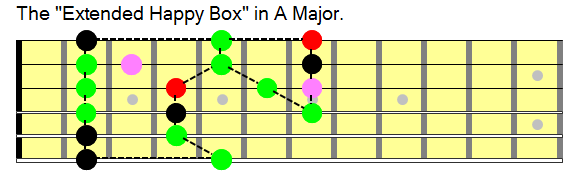
Remember, don’t try to play these shapes top to bottom. These scales are just pools of notes for you to use to build melodies. Get creative! Play the notes as many different ways as you can think of, and listen for the good stuff.
 guitarwithguffey